
From the Camino: One of the things you’ll notice in many places on the various Caminos is the placement of rocks on top of each other, on top of way signs, on top of walls, and especially between Rabanal del Camino and Ponferrada on the highest point on the Camino Frances, at the foot of the Cruz de Ferro, the Iron Cross.
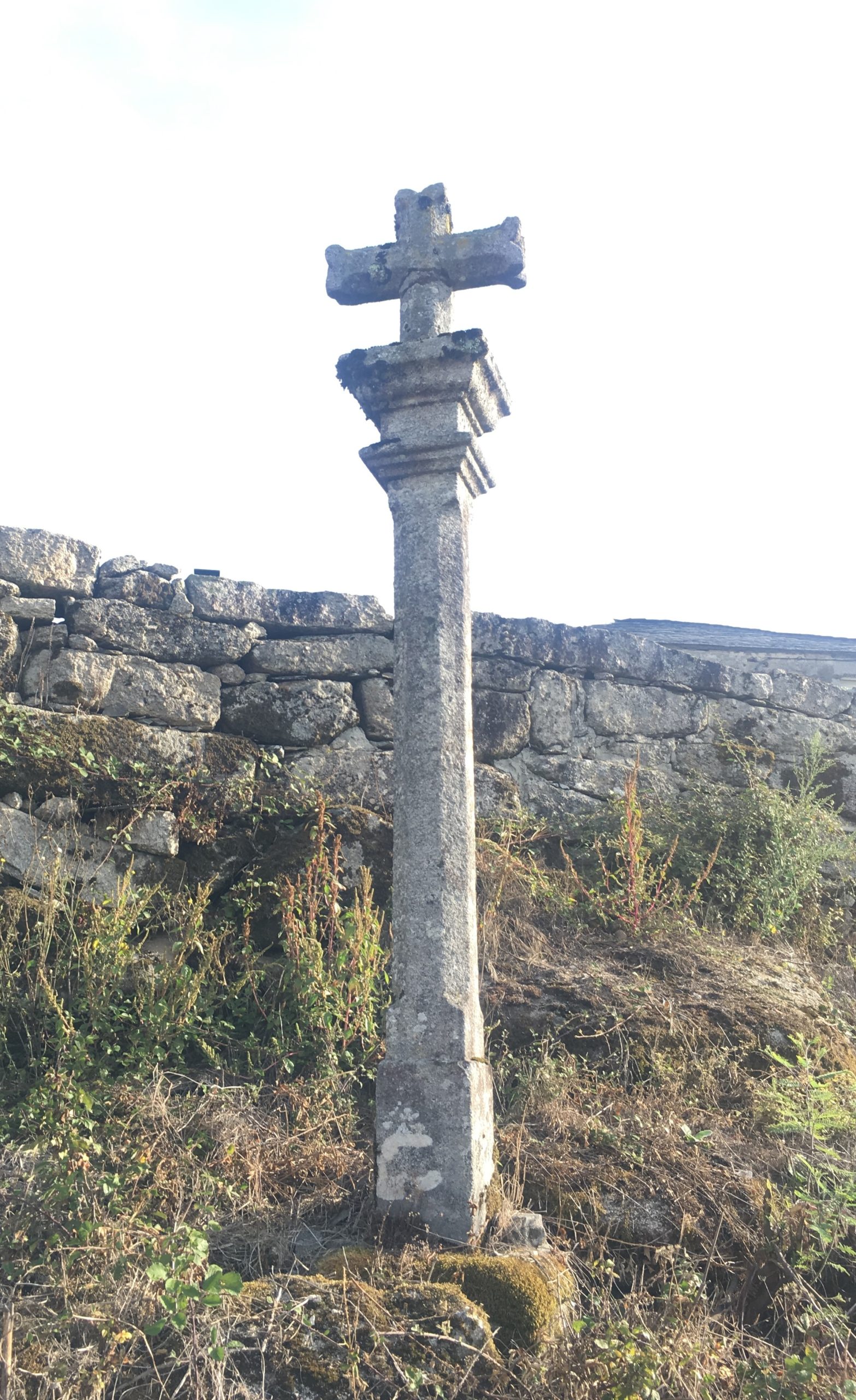 The custom is to bring a rock from home, signifying the burdens of your life. If you’re walking the Frances, you place it at the foot of the iron cross, a ritual act, a metaphor for leaving your burdens behind. For some reason the practice has exploded, and rocks are sited all over the place now.
Knowing this custom, while walking on Ormond Beach at home, I picked up a rock that caught my eye. It was heart shaped, all smooth on one side, but broken on the other. It seemed to me richly symbolic of the tension between the sometimes stormy interior reality and the calm outer appearance that I occasionally take on for a variety of personal and professional reasons. It captured my religious imagination.
I began to carry it on my training walks, carrying it in my left pocket. I must have carried it for over a thousand miles before I ever started the Camino. Occasionally, when particularly challenged by my inner concerns or the distance, the heat or by any disturbance, really, I would take that rock into my left hand, feeling both the rough side’s metaphor of struggle, and the smooth’s representation of my hopes for peace and a better future. It really was a very hopeful, comforting rock for me.
So I carried it with me on pilgrimage as well. Because I was not on the Camino Frances, and there is no equivalent to the Cruz de Ferro on the Northern route, I resolved to wait for some place to make some inner sense to me. Perhaps, I thought, I would find a place that caught my attention, combining inner peace with beauty, where I would just know I was in the right spot. That was my intent. I held my rock with some frequency, especially when the walk was long, or at the end of my walk when I would be tired or hungry or cranky. It was like a friend, reminding me to choose the good, to be kind, to act with kindness in spite of whatever difficulty I was experiencing.
One day, though, I reached for the rock, and it wasn’t in my pocket. The seams in the pocket had come undone, almost certainly from the weight of the rock, and it had fallen out, I know not when or where. I hadn’t reached for the rock in a few days and, in fact, I couldn’t remember the last time I had pulled it out. My first thought was that I had been cheated of my ritual. My second thought was that the rock had chosen its own time and place. As I hadn’t reached for it, or even thought about it for several days, it had done its job.
Psalm 126: 1 When the Lord restored the captives of Zion, we thought we were dreaming. 2 Then our mouths were filled with laughter; our tongues sang for joy. Then it was said among the nations, “The Lord had done great things for them.” 3 The Lord has done great things for us; Oh, how happy we were! 4 Restore our captives, Lord, like the dry stream beds of the Negeb. 5 Those who sow in tears will reap with cries of joy. 6 Those who go forth weeping, carrying sacks of seed, will return with cries of joy, carrying their bundled sheaves.
For reflection: Life can leave us encumbered by any number of weighty burdens. We can release sin in the grace of the sacrament of reconciliation, in confession. It’s a ritual that carries with it promises of the Lord, that what is unbound by the Church on earth would be unbound in heaven.
Some emotional cargoes, though, are not tied to sin and reconciliation. They have many causes: loss, regret, broken relationships, divorce, death, failure, tragedy, natural calamity, betrayal, etc. Some carry a sense of responsibility, but many do not.
We can live with deep burdens for many, many years. What we carry may well be a stone of heartache if we’re widows or widowers, if we have estranged family members, if we’ve been passionately in love and been destroyed, if we’ve lost homes, if it has dawned us that the world wasn’t what we thought it was, that our family and friendships weren’t what we thought they were, or that we, ourselves, aren’t who we thought we were.
Rituals can speak to a deep place in our consciousness. They help us concentrate and allow us to narrow our focus. They lend the inner work of our minds and hearts a tangible hook to cling to, to hang our feelings on, to either cling to or be free of the profound matters of our hearts.
And so we use a simple rock, carried, as are our burdens. The stone becomes heavy in our consciousness as we allow it to take on the significance of all the pain and loss, the difficulty and struggle, the doubt and anxiety. Then we make the decision, having imbued the rock with its emotional weight, to resolve what we can, to accept what we can’t change…and to let it all go.
Perhaps once liberated, we can finally live.
