
From the Camino: By the time I got to Tineo, with my exploded blisters, I had been on pilgrimage for thirty-three days. The pattern of my days had become set, and I was happy with that. My days had a good rhythm.
The blisters broke all that. I went online to investigate how to care for a serious blister. The advice was clear: “Don’t walk on it!” But here I was, having walked the whole way so far, with a sense of pride in my accomplishment…and I had a choice. I had made reservations in Pola Allande, and it was too late to back out without loss of money. Here’s the problem with making arrangements ahead of time, by the way.
One option was to keep on walking, which seemed medically unadvisable. The second was to take a rest day in Tineo, but I’d lose the payment I had made for the night in Pola Allende. The third option was to take a day of rest and use a taxi.
I was tempted to keep on walking – oh how tempted I was to tough it out – to maintain my idea of a “perfect” pilgrimage without using any public transportation. It was a stupid macho thing, a perfectionist’s perspective…just the kind of thing the Camino is very good about beating out of us.
Looking ahead, I could see that, by this late point in my pilgrimage, I needed to keep moving to achieve my arrival date in Santiago, affecting other travel commitments. So staying in Tineo wasn’t really an option. The only choice left was to take a taxi to my already reserved room in Pola Allende. But that led to it’s own crisis. What I really wanted was to be able to say that I walked every step without help. But I truly needed the rest…and the help. My idea of the perfect Camino had to die.
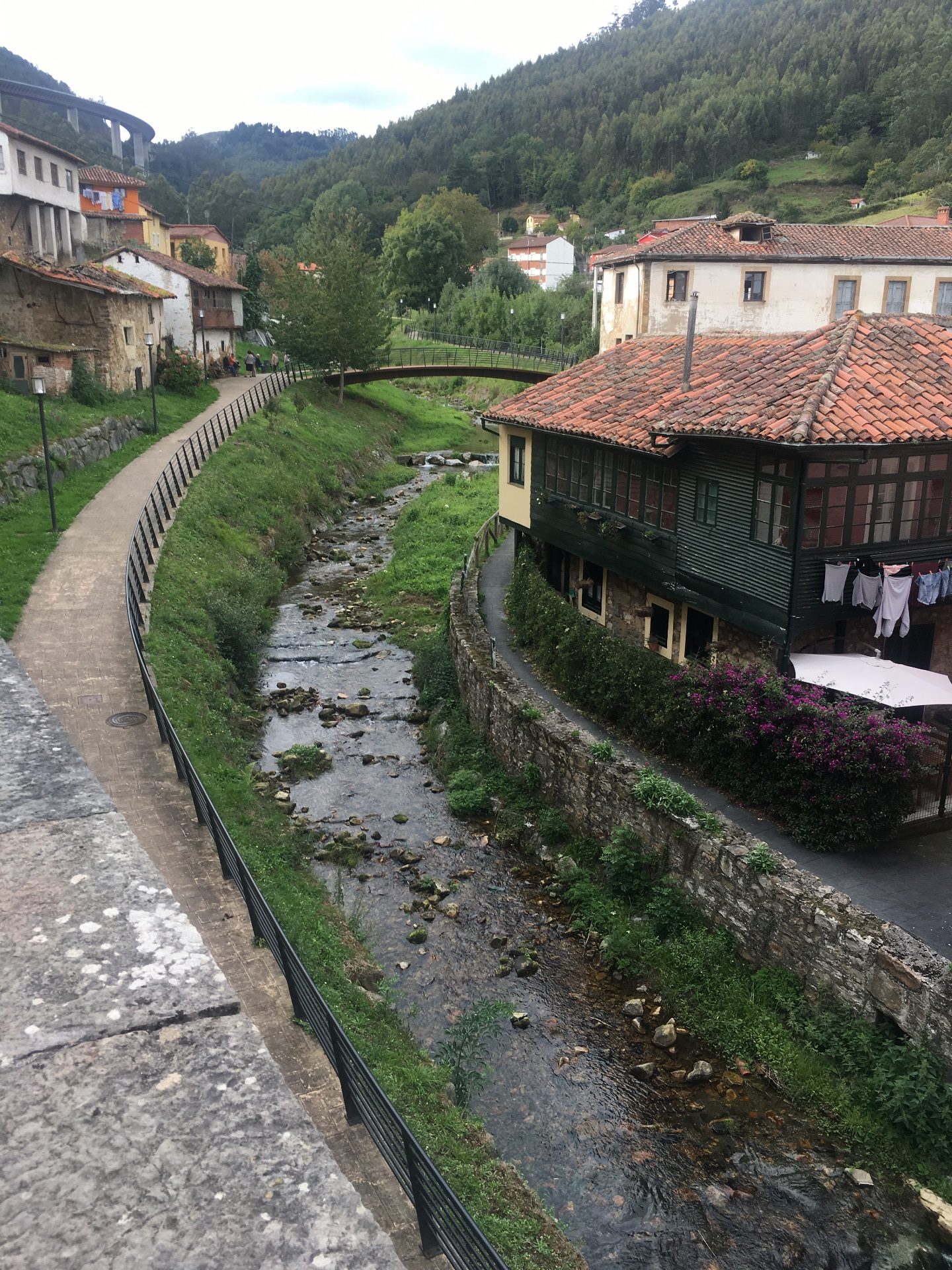
The next day I took a taxi to Pola de Allande. It felt like a defeat, but at the same time I was relieved. I had spent the prior afternoon in Tineo, caring for the blister as best I could. For the next day and a half I stayed off of my feet except for meals and a slow, measured walk along the Rio Nison, a lovely trout stream that ran through town. Curiously, that was all it took, for after that day-and-a-half of rest, I was able to set off again without any great discomfort for Berducedo. The only thing I had to leave behind was my sense of what made for a worthy walking pilgrimage.
Jer 19:a, 4b-5 – 4b Thus said the Lord: “…They have forsaken me and profaned this place by burning incense to other gods which neither they nor their ancestors knew; and because the kings of Judah have filled this place with innocent blood, 5 building high places for Baal to burn their children in fire as offerings to Baal—something I never considered, or said, or commanded.”
For reflection: Throughout history people have done a great number of things for God that had nothing to do with God’s desire. Humans have gone to war against each other in God’s name. Some have taxed peasants for God’s churches. Others have persecuted Jews and gypsies, heretics and agnostics, gays and lesbians, for God’s sake. As in the Scripture passage above, some cultures have even sacrificed human beings “for God.” God and faith have certainly been used to forward all sorts of political causes, with only the slightest veneer of spiritual interest on the part of the perpetrators. It should be easy to see how clearly misguided those efforts were.
Somewhat less clear, are our every day, quotidian efforts to do what is right. What is it that God would ask of me in this moment? What would serve the Kingdom? It’s noble to attempt a disciplined and focused life. It’s right to choose the difficult and narrow way. It’s loving to sacrifice time and effort to achieve the good. It’s possible, though, in each of these cases, to miss the mark.
Anything taken to extreme can do damage.
Discipline can be harsh, focus ruthless, the narrow way exclusive and judgmental, and sacrifice destructive. It’s possible to be so fearful of being too lenient, that we become too fierce, with others, and perhaps ourselves. We can be so dedicated to a lesser good, that we sacrifice a much greater good. We are always at risk of observing the law, while failing the purpose for which it was laid down.
At the moment our efforts no longer serve the greater commandment to love, either neighbor or self, we risk harm, even great harm, and no longer serve the Kingdom.
On the Camino, where conditions can be extreme, the day hot, the shoes uncomfortable, the albergue noisy, we may have to be more careful, rather than less, to achieve a balance that serves others and self – and that is the commandment: “Hear, O Israel! The Lord our God is Lord alone! 30 You shall love the Lord your God with all your heart, with all your soul, with all your mind, and with all your strength.’ 31 The second is this: You shall love your neighbor as yourself. There is no other commandment greater than these” (Mark 29-31). Part of the balance, is to include, in that pyramidal structure of loving God above all, and then loving both neighbor and self, a healthy level of self-love, neither minimized nor exaggerated. That always requires significant consideration, something we have time for on the Camino.
Ultimately, the goal is not to achieve…but to be transformed. That may mean relaxing one discipline and picking up another, shifting focus off of hurts and pains onto what serves and heals, taking a different narrow, yet graced, way, and to question the value of our sacrifices – perhaps to maintain them – or to set them aside for a yet greater good.
In the silence and expansive time on the Camino, we can ponder, set aside, and then return to these questions of how we are to live, what really matters, and what serves the One we would worship.