
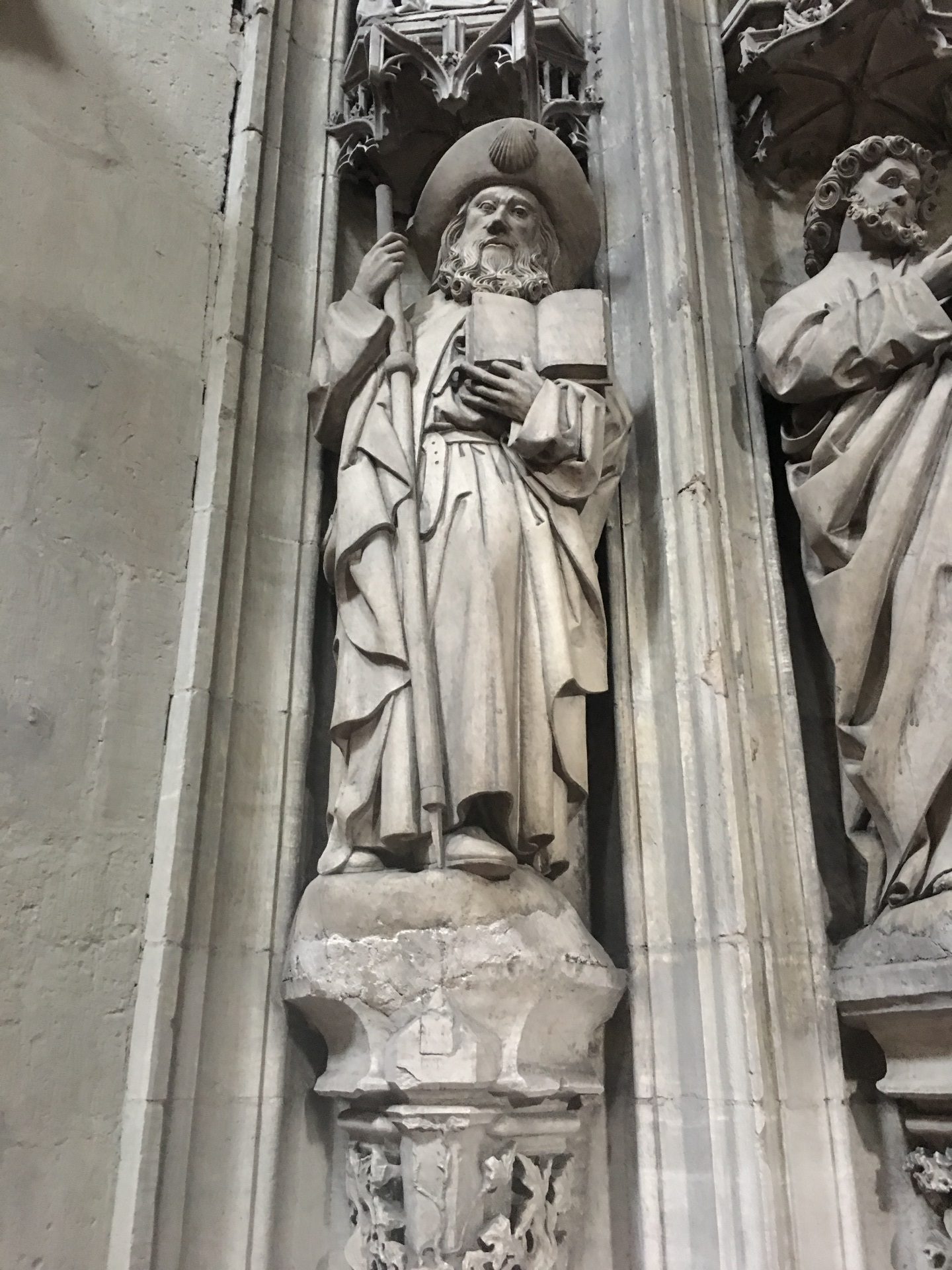
In our modern conception of the pilgrimage to Santiago de Compostela, the pilgrimage starts when one starts actually walking. A traditional place for the Camino Frances is in Saint-Jean-Pied-de-Port. It takes thirty two or more days walking 791 km or 490 miles, concluding with arrival at Santiago. In this calculation many don’t include the time set aside time getting to the start of the foot journey, including plane, train and car travel times, and often they exclude the time returning home in their accounting of the time of pilgrimage.
In medieval times, however, one’s pilgrimage started at one’s front door or in one’s parish church. You either put on your heavy, warm cloak folder, or folded it and threw it over your shoulder like a poncho; you picked up your pack and you started walking, and perhaps sailing or riding, depending on the destination and the means you had available. After arriving at the destination, be it Jerusalem, Rome, Santiago, Chartres, etc., the pilgrimage was not complete. You’d only done only half the journey. The journey homeward was as much a part of the journey as the trip to the holy place. You couldn’t just jump a train to the plane to the car to get home. You returned the way you had come, by the means available to you, boat, horse, ass or by foot, walking the whole way back, digesting the fruits of your encounter with the holy. What was new? Should I be the same when I return? Do I continue in the old way of being? How do I integrate the gains of a thoughtful, prayerful pilgrimage, into my life at home?
In the eleventh and twelfth centuries, the peasantry gradually found their way out from under the domination of the feudal bonds that kept them chained to the land and control of the nobles. One result of this was they took to pilgrimage in every greater numbers. The vast bulk of these peasant pilgrims were uneducated and illiterate. For them, the church buildings, their art and windows, and the splendor of their reliquaries were all a part of communicating to them the significance of the places they were visiting.
The role of tourist guide predated Christianity in the religious practices of the ancient Greeks. Both travelers and pilgrims, in that early point in history, visited their holy sites, cultural centers, and the seven wonders of the world, taking along with them guidebooks, one of which exist to this day. In Pausania’s ten volume Description of Greece, he recounted his travels, the buildings and artwork he saw so descriptively and accurately about locations that still exist, that we have come to trust his descriptions of no longer extant sites.
From the many descriptions people left recorded for us, we know that from very early in the church’s history, pilgrims were also given helpful guidance in many sacred Christian sites. These “interpreters” helped them decipher the significance of the history, art work and architecture of the holy site, so that they could enter more deeply into their pilgrimage experience.
For those few who were literate and understood Latin, large written texts were provided in some churches and shrines, serving the same function that explanatory placards provide today to educated visitors. A number of ancient sources also describe tours led by local priests, bishops, monks, abbots, and both official and unofficial lay guides, providing a richer experience for the pilgrim at distinct places, and sometimes entire regions. The Franciscans were noted for their tours of the Holy Land, especially Jerusalem and it surrounding sites.
The larger the shrine, the more important the saint, the greater the number of attendants to assist the visitor. Canterbury Cathedral, with over fifty lay workers and an additional number of monks, was well staffed to maintain and guard the cathedral and its art from damage or theft, an occasional occurrence. Its shrine of St. Thomas a Becket, alone, had four regular attendants. These workers were variously tasked with welcoming and sheltering pilgrims in the hospice, instructing them, interpreting, leading in prayer, providing Mass and confession, blessing pilgrims, their food and mementos, and providing for the sick. They would explain the relics and recount the important events and miracles that had happened at the site, perhaps relating the life story of the local saints. The shrine’s monks and clerks were instructed by to “always, and in all circumstances, speak in a friendly manner with pilgrims, and answer them with all gentleness, courtesy and care.”
In smaller, less developed holy places, very often, the porter, who opened the church for visitors, would have served in this role – the position of porter is one that visitors to smaller towns and cities today will miss when they come upon the local church, only to find it locked tight.
In the Rule of Benedict, monks were instructed to welcome all guests as though they were Christ, himself “for he will say, ‘I was a stranger and you welcomed me”” (Rule of Benedict, 53:1; Matthew 25:35). Monasteries across Europe hosted visitors in their hospices. The large dormitory hospices might not have been fancy, but they were dry, and the food was inevitably simple but nourishing fare. There were also nicer accommodations for the nobility, according to their station in life. They might be expected to leave a donation for their more pleasant lodging.
There were no yellow arrows to guide the pilgrims from place to place, but there were stage by stage guides, such as are found in the Bordeaux Pilgrim (333 AD, anonymous). It gave basic distances, with just scant information on a few sites along the way, until it reached the margins of the Holy Land, Sidon, where the writer became more descriptive, providing connections to places and biblical moments in both Old and New Testaments. His stages, where he changed horses, ranged from nine to nineteen miles for the most part, with many of them concentrated between eleven and fifteen miles in length. The journey took the pilgrims across southern Europe by land, from the city of Bordeaux, through Constantinople to the Holy Land, and back by way of Rome to Milan.
People of every social class went on pilgrimage. In Chaucer’s Canterbury Tales, composed towards the end of the 14th Century, we discern a certain affluence in the members of the pilgrimage companions on their way to the tomb of St. Thomas a’Becket. A monk, , wore a gold pin to keep his hood in place. A merchant wore a beaver hat made in Flanders, and a lawyer wore a belt of silk. A widow from Bath had brightly colored socks, new shoes and wore pearls. Being wealthy, she had also made pilgrimage to Jerusalem, Rome, Bologne, Santiago and Cologne. The man who dealt in indulgences wore a pilgrim badge from Rome. All of these are signs of more than adequate means.[1]
[1] Margrete Figenschou Simonsen, “Medieval Pilgrim Badges: Souvenirs or Valuable Charismatic Objects?” p. 185.
The trouble is actually with the English form of the name, which is not particularly close to the original biblical name. The closest English name would actually be “Jacob.”
Over time, the name has had a variety of forms in various languages:
This may be more than you ever wanted to know…but there it is.