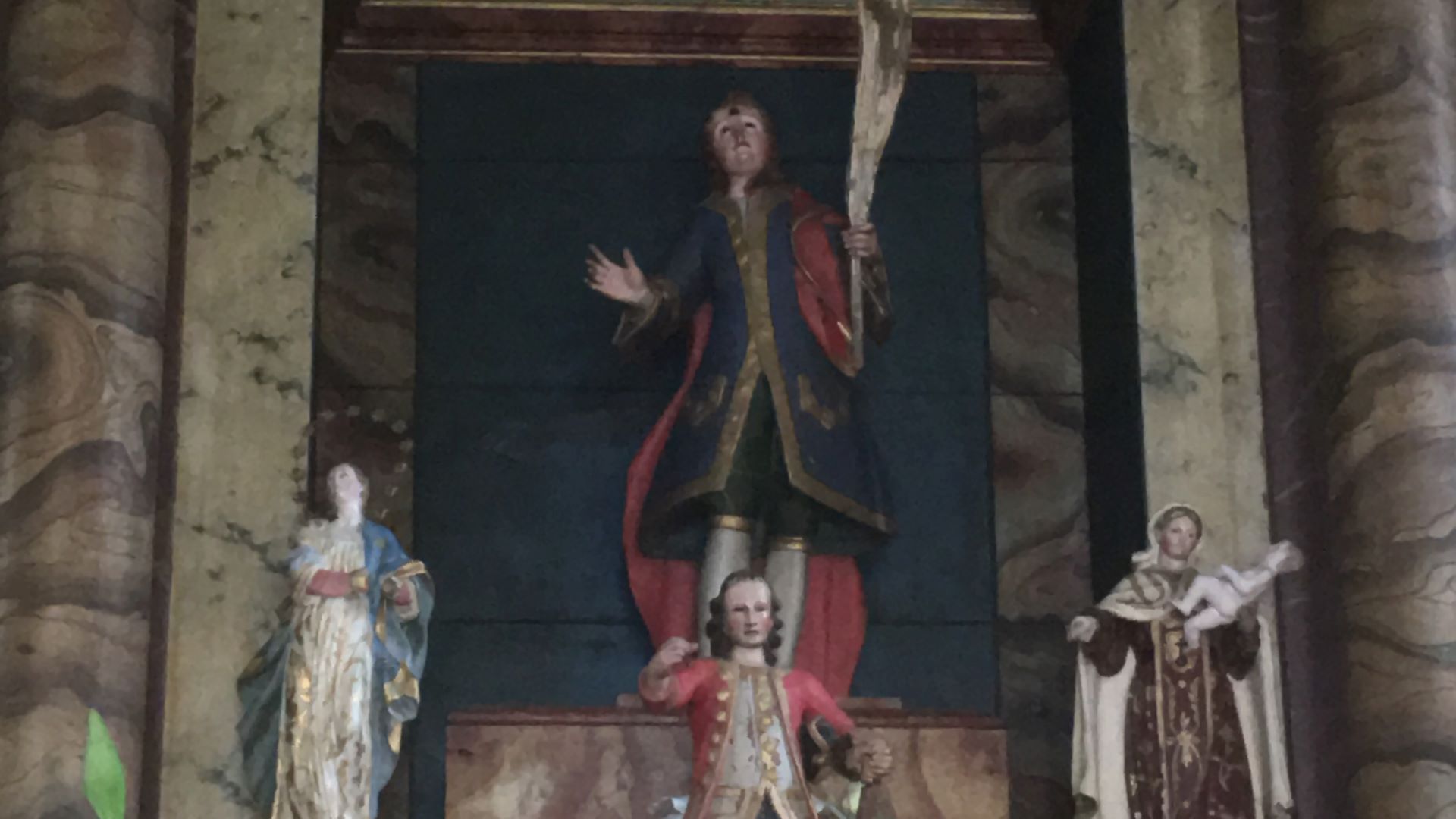
From the Camino: On Friday, September 29th I made my way to the outskirts of Santiago. There is a little chapel dedicated to St. Vincent de Bama in the hills just outside of the city. Truth to tell, I was a little distracted by the weight of completing my Camino. I was very filled with the significance of all that I had done, all that had happened, everyone I had met.
I was pleasantly surprised that the church was open and made my way inside. I found myself in a simple place of prayer, small enough that at first I thought it was only a chapel. There was nothing of the fanciful baroque there. The walls were painted to look like marble, and the statuary was unimpressive, not that it mattered to me. I was, perhaps more at rest without the Baroque curlicues of so many Spanish churches.
There was a short line of pilgrims making their way to a table that had been set up for pilgrims to stamp their credential. The thought occurred to me as I joined the line, myself, that this would be my last sello, my last stamp, before entering Santiago.
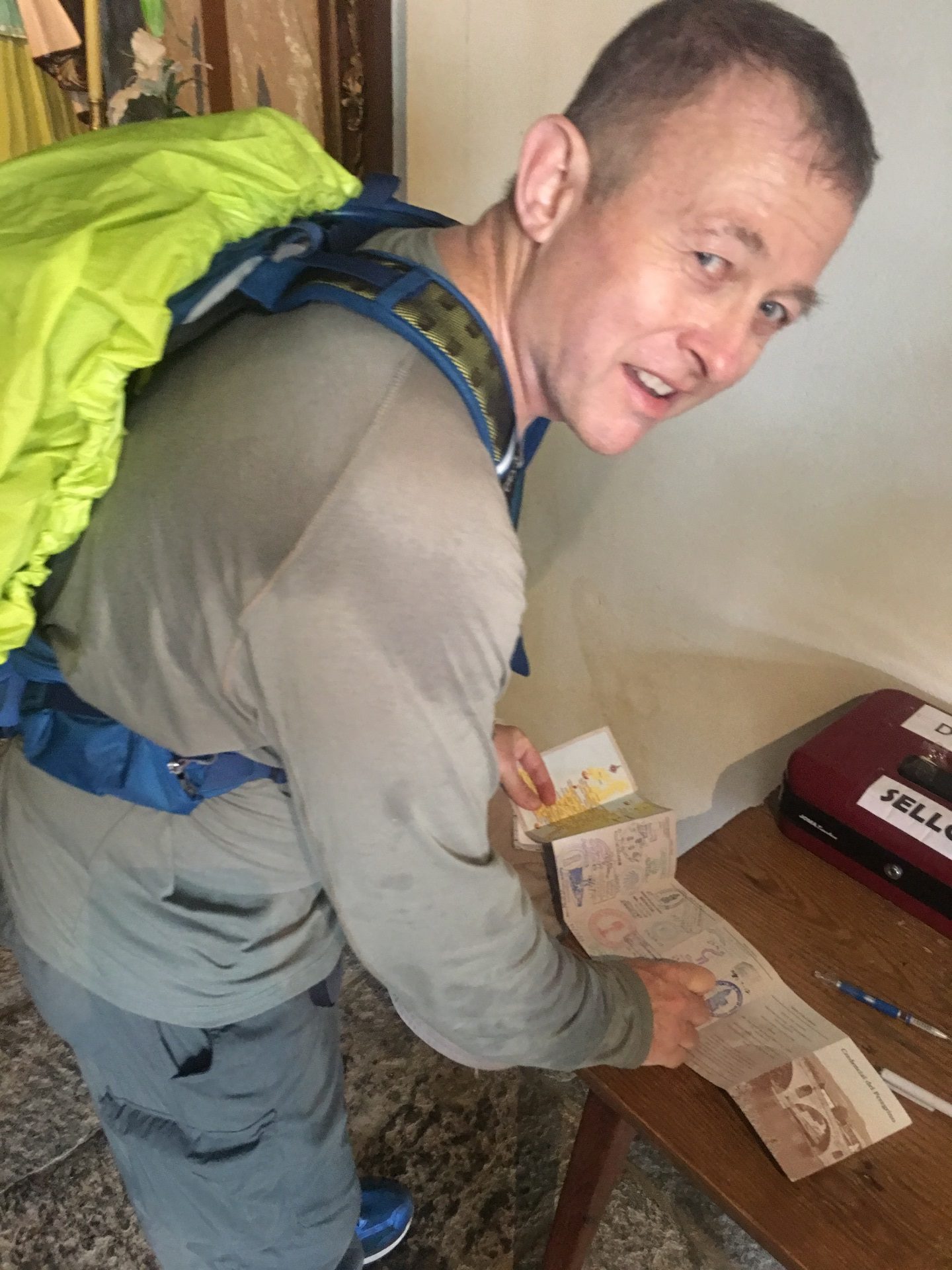 It seemed too significant to let this moment pass lightly. I turned to the pilgrim behind me and asked her if she would take my picture as I stamped my passport.
It was odd. I had been on the way for weeks. I took a couple of selfies when I started, and then quickly abandoned the practice as I really didn’t need to be in my own pictures. I took lots of pictures of places and people. I was in some group pictures that got passed around. But up to this point I had never asked anyone to take my picture.
Most of us are quite unimpressive while on pilgrimage. I was no different. I had been rained on earlier that day, and was still wet. I still wore my pack with its blinding yellow rain cover over it, and its straps squeezed my body, as if to emphasize where I could lose some pounds. It was altogether unflattering. It didn’t matter to me. I remember how I was feeling, how excited I was. It was a conscious decision not to enter Santiago that afternoon, and to wait till the next morning. It was too momentous to me, and I needed to process it all, and I didn’t want to rush it.
So, after stamping my passport, I made my way to the front of this most unimpressive church, sat down, and inexplicably burst into tears. I surprised myself completely. I’m not a weepy kind of guy. But there I was. I wasn’t sure that I’m was going to be any more moved by walking into the cathedral tomorrow.
Joshua 3:14-17 — 14 The people set out from their tents to cross the Jordan, with the priests carrying the ark of the covenant ahead of them. 15 When those bearing the ark came to the Jordan and the feet of the priests bearing the ark were immersed in the waters of the Jordan—which overflows all its banks during the entire season of the harvest— 16 the waters flowing from upstream halted, standing up in a single heap for a very great distance indeed, from Adam, a city in the direction of Zarethan; those flowing downstream toward the Salt Sea of the Arabah disappeared entirely. Thus the people crossed over opposite Jericho. 17 The priests carrying the ark of the covenant of the Lord stood on dry ground in the Jordan riverbed while all Israel crossed on dry ground, until the whole nation had completed the crossing of the Jordan.
For reflection: For forty years the Israelites had wandered in the relentlessly stony, desiccate deserts of the Negeb. Entering the Promised Land was a momentous, even holy moment for God’s people. They had waited for an entire generation to die away before they made their way into the land God had prepared for them. I can’t imagine just how moved they must have been by the significance of it all…with the strong knowledge that their God accompanied and led them. The ark of the covenant, their most precious possession, led the way into the water of the Jordan, damming it upstream so that the people could cross dry-shod.
Biblical history teaches us that entering the Promised Land didn’t release the Israelites of all their troubles, nor does our arrival at the end of our Camino resolve everything that life will throw at us in the future.
Yet the entrance, itself, either into the land for the Israelites, or into Santiago for the pilgrim is a holy act. It’s too rich an act, in itself, to let it pass unremarked.
The people followed the ark across the river bottom; its presence signaled the presence of their God with them. If we do our pilgrimage open to the holy presence of God, we will inevitably have had many opportunities to find the Lord walking with us on our way. Would that ever be any more appropriate than entering Santiago de Compostela?
Perhaps that holy Presence will bless you with signs and wonders at your own Jordan.
The trick will be negotiating life with the Lord as a constant companion…because, even though you make your way into the burial city of the apostle James, Santiago the pilgrim, the journey is not complete.