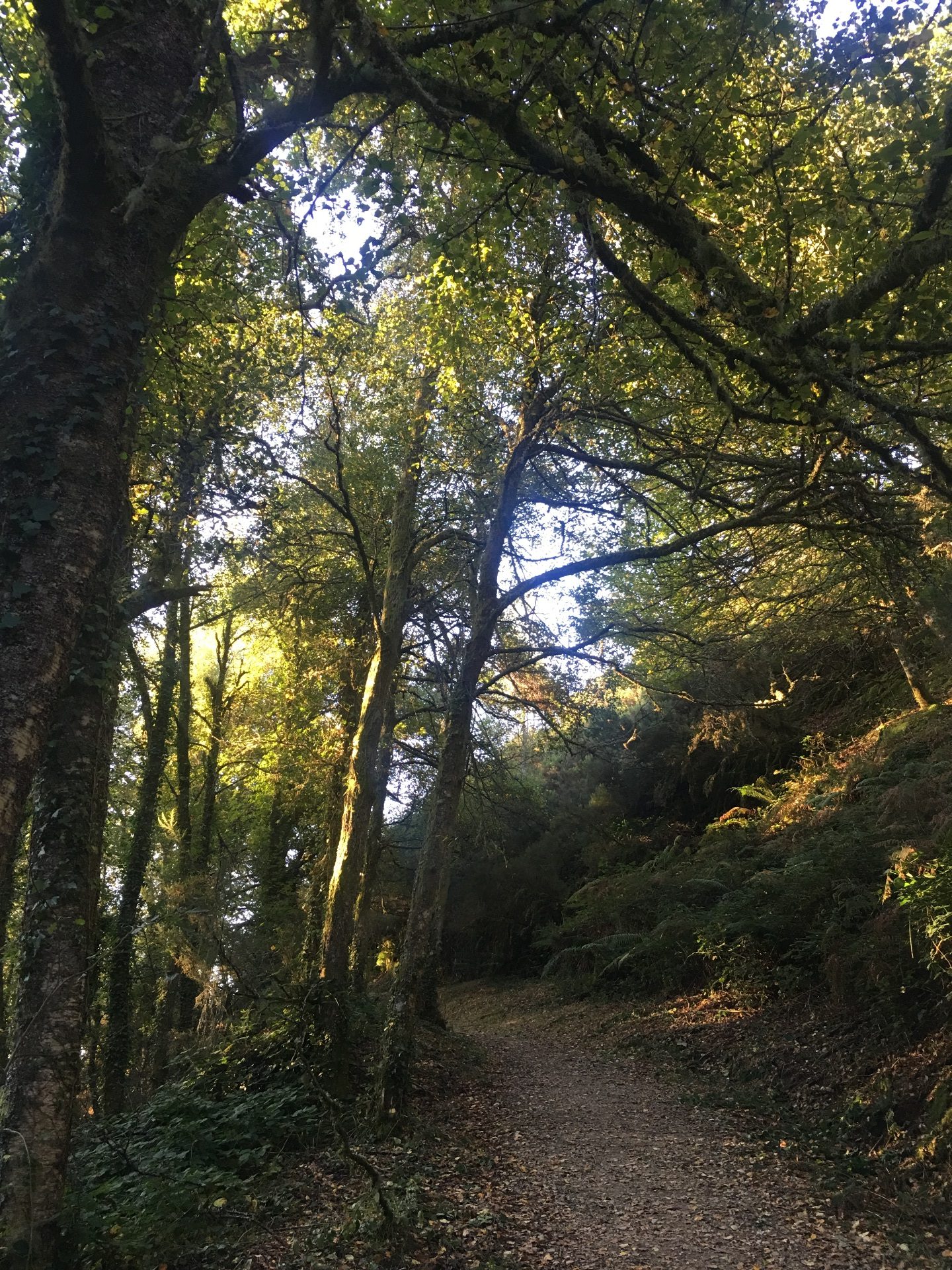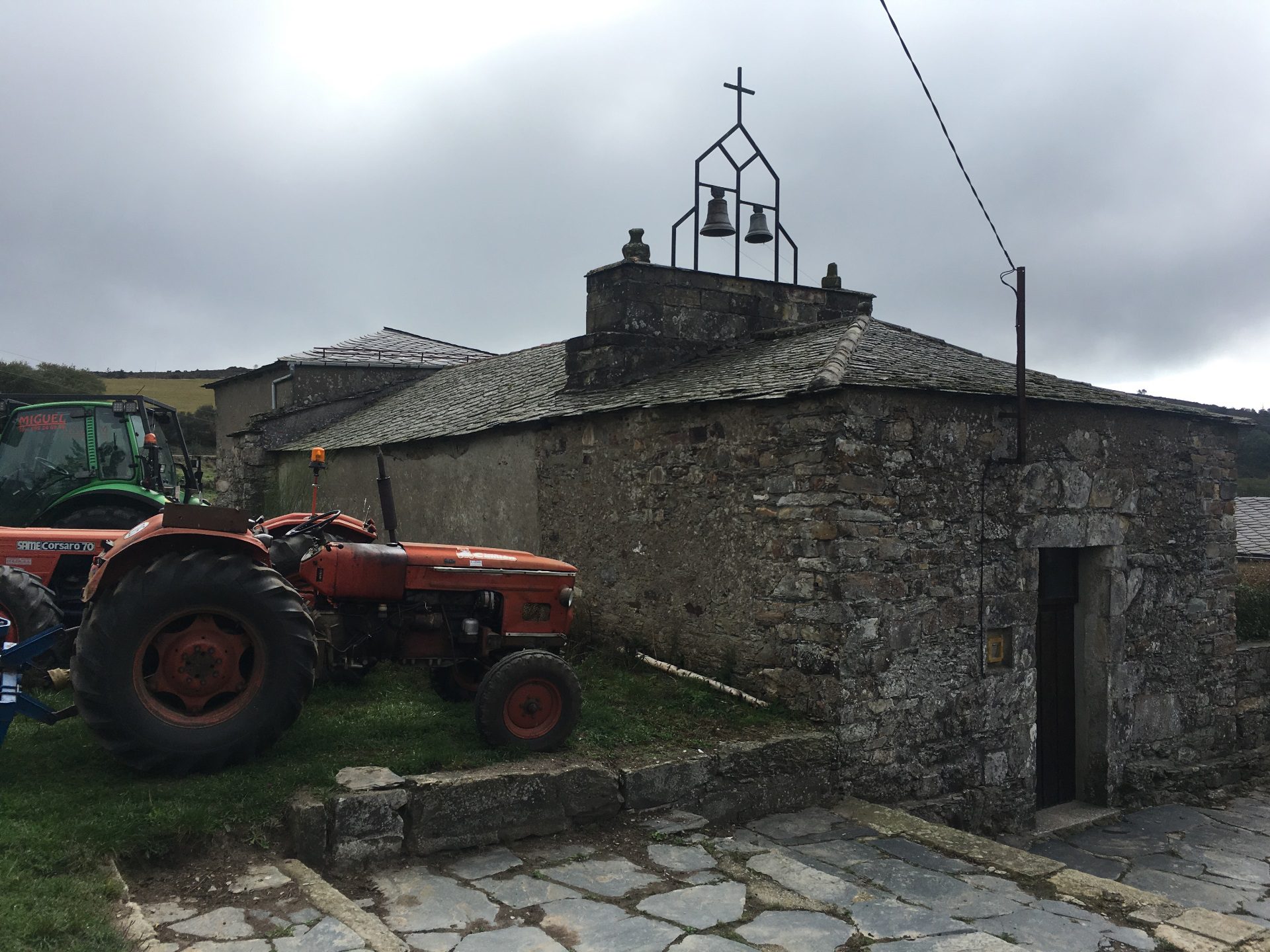
From the Camino: Before I left for each Camino, I asked my parishioners to send me the prayers of their hearts. I made a commitment to pray for them on the way. It became one of the surprising graces of the Camino.
Every time I came to a church, a chapel or a shrine, be it open or, more likely, be it locked, I would set down my pack for a moment, pull out my iPhone, and I would pray my way through three, four or five of their intentions, depending on how long they were. There are enough churches and shrines in northern Spain to keep me invoking God’s attention and mercy several times a day.
The prayers, themselves, were unquestionably beautiful. People prayed with such heart for the sick and aged among them. They prayed about someone’s job. They implored the throne of grace for their adult children and grandchildren. And often enough, they would finish their list of intentions simply with “…and for me.” There were intentions from people whose names I didn’t recognize, but who I came to have the deepest affection for, anonymously, because of the depth of their intent. I couldn’t help but be moved by the selfless goodness revealed in people’s prayers.
This recurrent prayer began to have its own impact on my awareness of God in the more extended stretches that linked the moments of intercession. It’s not that I didn’t frequently get lost in my own head because, professor that I am, that is what I do. But often enough, I found the presence of God intruding with ever growing frequency, even in those head-trip moments. Within just a few weeks, my Lord Jesus had become my constant and affectionate companion. As I trusted so much more easily in his concern for the people I was praying for, I began to surrender more readily to his fondness for me.
Gen 3:8-9 – 9 When they heard the sound of the Lord God walking about in the garden at the breezy time of the day, the man and his wife hid themselves from the Lord God among the trees of the garden. 9 The Lord God then called to the man and asked him, ‘Where are you?’”
For reflection: As a biblical scholar I take the stories of Adam and Eve as metaphorical, and not historical. This doesn’t mean false or readily dismissed. It just means a shift in purpose.
The purpose of historical texts is to inform us of what happened, hopefully with as little spin and as much objectivity as possible. We have become remarkable skeptical of the ability of historical texts, or news sources, to actually be objective, now when there is actually a science of historiography. It is so improbable to expect the goals of accuracy and objectivity from texts of the ancient world where that science didn’t exist.
Metaphorical texts, though, may have any number of purposes – to entertain, to explain, to edify, to challenge. When done very well, they can help us address our deep desire to understand ourselves, our purpose, our place in the cosmos. When Scripture passages are metaphorical or mythic, they often express the desire of God to be in conversation with us, leading us to the truest self-understanding.
In part, this story of Adam and Eve speaks of human longings, of which we have no shortage. Call them yearnings, call them “itches,” call them “hungers,” call them “compulsions.” Call them what you will. We yearn for stability, for relationship, for possessions, for adventure and thrills, for purpose, etc., but especially for meaning.
In a metaphorical sense, the passages on God’s earliest creation of the garden is laden with significance beginning with his populating of it with Adam, a man whose name in Hebrew means “human,” and Eve, whose name in Hebrew is rooted in the semantic range of “life.” Resonant through all the millennia in which this tale has been told, is the small detail, often missed, that in the cool breeze of the evening, God came looking for his son, his daughter, calling out, “Where are you?”
There is, built into the story, an explanation of our human sense of being uprooted, a longing for our primordial home, a place where we belonged and felt it. It springs, perhaps, from our constant yearning for that time in the recent past, when things, with rosy colored glasses, were more settled, more orderly, more devout, more economically settled and prosperous, when people all behaved the way they were supposed to act, and no one lived in fear. That time is a fiction, of course, because when you go back to the recent past, with all its rosy colored glamour, you find that the people of that time yearned for a prior and better past before them, as did those people of that prior age, extending, generation after generation of longing, almost certainly, back to the primordial Eden, itself.
How does this apply to pilgrimage? In the normal pilgrimage, one confronts life’s yearning directly. The pilgrim leaves stability behind for the uncertainty of travel, and often leaves key family and friends behind, for the casual companionship of the road. Normally most of one’s possessions, except those stripped down daily essentials, extraordinarily few as they turn out to be, are set aside for a while. The openness of pilgrimage, without trade, community, parish or ordinary life distractions, leaves the whole pursuit of purpose exposed in a bare, even raw way, inviting its closest inspection.
And we just may discover that Eden, from which we have been driven, is recoverable – but that it’s not a place we need to return to, but rather a new way of being in the present moment. Any number of approaches are possible. Serious pilgrims may well find that any prior balance between the people who inhabit their lives, the possessions in which they have found security, and the jobs in which they obtained a sense of purpose, will all be upended.
Some pilgrims will return, having reassessed the consumer driven focus of our culture, in light of their surprising contentment in the simplicity of their pilgrims’ way, willing to embrace the happiness of a simplified life.
Some will return, having deeply missed their family and friends, with a much deeper appreciation for them. Some will make the opposite decision, to end certain relationships. In the space that pilgrimage provides, it will become clear in the surprising peace and joy that results from their absence, those people in our lives who are poisonous and damaging.
Some, having been confronted by the profound goodness of the people they met in passing on the road, return with a renewed love for humanity and a repaired openness to the people who pass casually in an out of our lives.
Some will return with a renewed, deepened sense of gratitude to God for the warmth and comfort of one’s own bed, one’s profoundly loved companions, one’s deeply appreciated co-workers, and one’s reset sense of purpose.
For the truly spiritual seeker it might not be enough that we reconnect with our need for each other. In our ancient stories there was an original intimacy with God, and a memory of divine proximity. And so we found God, astride in the garden, in the cool breeze of the evening, seeking his children and calling out to us. This intimacy was our birth right; to be in relationship with God was an even deeper purpose than the care of the garden. Eden, was a place where God walked among us. It was the original temple, the earliest dwelling of God among us. The tent of meeting and the ark within it, along with every temple and tabernacle, including every church and its altar within it, are reminders of this intimacy. In them we can still feel the cool breeze of the evening and remember…
Perhaps two of the most important tasks of the Camino, are to make peace with our past, and to find the joy of God’s presence in the present moment. Eden is where you find it.