
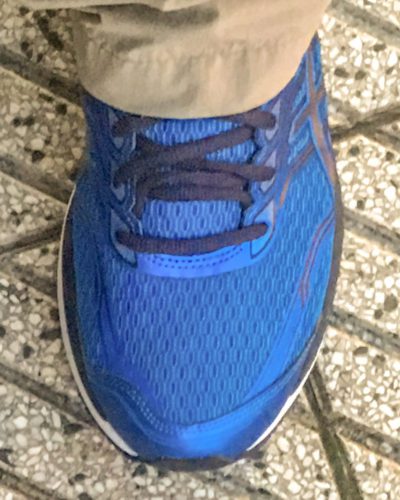
 From the Camino: We return to Oviedo, to the department store where I brought the shoes that gave me the blisters that lead to my “achievement” crisis. I was distressed to see that the shoes were colored a shade of electric blue that stood up, saluted, and demanded attention. I know that many young people have a preference for brightly colored shoes. I don’t share their sense of fashion. If no one ever notices my shoes, it’s a good day. How unlike my sisters I am.
I remember my very words, in Spanish, to the salesman: “¡Odio el color!” – “I hate the color!”
He smiled and said in so many words, “Tough luck! These are the shoes you need. You Americans have big feet, and this is all I have in your size.” So, I ended up spending more than twice than ever before on a pair of shoes whose color I detested.
Moving two days into the future, if you will recall, it rained heavily on the way into Tineo. As I said above, I had read that in the best of times, that rural trail of the Camino was muddy and in the rain would have been even more slippery and filthy. In taking the road, instead, my feet hurt from the wet blister, but at least the bright blue shoes were clean.
Some days yet later, I met some companions on the way. They shared with me how they had walked the muddy rural path, how awful that day had been, and showed me their filthy, muddy shoes. Knowing that I had left the same town, on the same day, one of the men asked me how I had kept my shoes so “bright and clean?” I explained that I had taken the road.
One of the women, then commented on how nicely my shoes matched the color of my backpack. It was true! The backpack was a gift from friends back home. The blue of the shoes matched the color of my backpack exactly. How do I explain that electric blue in a backpack seems fine to me, but in a pair of shoes seemed way too loud?
So now I looked…how can I say this…precious?
I can remember my sister commenting later, in disbelief, “You mean you didn’t match the color of your shoes to your purse?” It is what she would have done. Of course, my backpack wasn’t a “purse,” and no, I would never intentionally aim for that kind of personal décor. But there I was, on the Camino, with matching electric blue shoes and backpack.
No, it didn’t really matter. It was a point of fun conversation between me and my Camino friends for the next few days. Every one becomes a bit grimy after weeks of walking and wearing the same shoes and clothes, day-after-day. There is no fresh new outfit for dinner tonight. There is no shiny new gear to show off. Even electric blue shoes lose their luster, and it didn’t even take a week, in fact.
From the life of St. James – Luke 9:51-56 – 51When the days for his being taken up were fulfilled, he resolutely determined to journey to Jerusalem, 52 and he sent messengers ahead of him. On the way they entered a Samaritan village to prepare for his reception there, 53 but they would not welcome him because the destination of his journey was Jerusalem. 54 When the disciples James and John saw this they asked, “Lord, do you want us to call down fire from heaven to consume them?” 55 Jesus turned and rebuked them, 56 and they journeyed to another village.
For reflection: We have subconscious, survival oriented and biologically driven reasons for maintaining our social position with others. At one time, in our hunter-gathering days, that place in our small wandering band, might very well determine whether we ate, or mated, or stayed alive.
In business and in politics one’s status is still of immense importance, and people pay dreadful personal, inner, prices to maintain what are often false fronts. The business of discovering and revealing the peccadillos of the rich, famous or powerful drives the profit margins of the free press. We can’t pretend our place in society doesn’t matters in our work or in our relationships. It’s part of what it is to be a herd animal, and in human terms, a social person. Because of that physical, animal, drive, it’s hard for us to know, sometimes, when to surrender on our personal dignity.
James and John wanted to defend Jesus’ social standing, perhaps because it reflected on their own. And Jesus, for whom social standing was pointless, would have none of it. Not only did they not get to defend Jesus’ dignity, in being rebuked, they lost some of their own.
Jesus, though, was truly unconcerned about his own sense of dignity. He didn’t need to be preserved from rejection by Samaritans, or Pharisees, or procurators. He was content in himself, in his relationship with the Father, and in his relationship with his disciples. And in this, he was free: free to associate with sinners, free to call the humble into discipleship, free to stand up to popular bullies (i.e., the Pharisees), and free to walk by, unaffected by rudeness from villagers. Who he was, and how he was, remained independent of others thoughts about him.
The pilgrimage has a way of helping us not take ourselves too seriously. And it’s always good not to take ourselves too seriously. So, when the only thing that is available are electric blue shoes, or a broad brimmed sun hat that your sisters find appalling (and even evoke comments from fashionably attired Spanish women), or zinc oxide sun block, or whatever else draws unfavorable attention, but serves the necessary purpose of keeping you safe, or warm, or protected…Be awkward. Be unfashionable. Be free. There are far more important things to ponder on the way.
