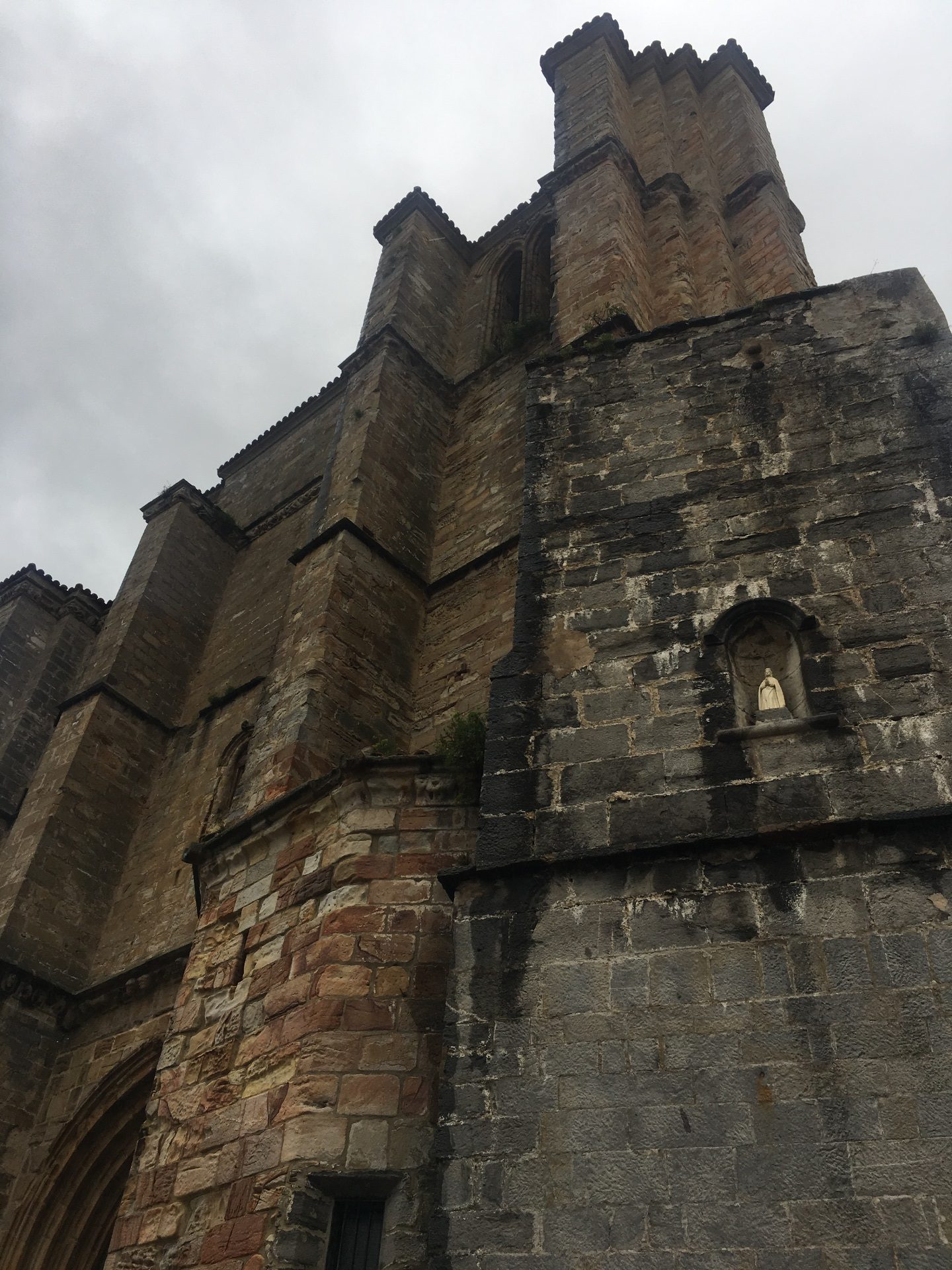
 From the Camino: While journeying through any place in Europe, you are bound to see a lot of ruins. This is no less true of Spain. Castles are expensive to maintain, abandoned churches are a great source of stone for people building their homes, villages thrive for centuries, and then fade into obscurity, leaving only the foundations stones as a trace suggesting someone once lived in a place, loved and brought forth a new generation.
While in Salas I stayed in the “palace” attached to the Castillo de Valdes. The place was first documented in 1122, though the palace of the Valdéz-Salas family, built by a founder of the University of Oviedo, wasn’t built until the 16th Century. And now it’s a hotel, with very simple accommodations – I’m sure I stayed in a servant’s quarters that hardly fit a set of drawers, a tiny table and a bed. It felt special anyway.
I wondered though, what became of the Valdéz-Salas family, how they lost this bit of their past, and if they even still existed.
From the life of St. James, Mark 13:1-7 – 1 As he was making his way out of the temple area one of his disciples said to him, “Look, teacher, what stones and what buildings!” 2 Jesus said to him, “Do you see these great buildings? There will not be one stone left upon another that will not be thrown down.” 3 As he was sitting on the Mount of Olives opposite the temple area, Peter, James, John, and Andrew asked him privately, 4 “Tell us, when will this happen, and what sign will there be when all these things are about to come to an end?” 5 Jesus began to say to them, “See that no one deceives you. 6 Many will come in my name saying, ‘I am he,’ and they will deceive many. 7 When you hear of wars and reports of wars do not be alarmed; such things must happen, but it will not yet be the end.
For reflection: All things come to an end: Herod’s Temple, the Roman empire that destroyed it, the Holy Roman, French and British empires that in turn replaced it, the stars that existed for millennia upon millennia and then exploded to create the stardust from which our earth was formed, our possessions, and our lives. We too shall pass.
Our jobs come to an end, too, and some of us need to ask the identity question, especially where we well may have wrapped too much of our identity in our job
Coming to grips with loss and mortality is one of the possible gains of a lengthy pilgrimage. You might even experience it as you walk. My second Camino began in mid-August and finished in the first days of October, giving me the green beauty of a Summer in Northern Spain, easing into the golden dying of the corn fields as Autumn arrived. If you have the good fortune to walk for several weeks on your Camino, you might experience something similar…be looking for the cycles of nature, and let them be part of the cycle of life and death, the coming into fruition of Spring, or the snowy barrenness of winter. Witness the building up of the soil, the seed and the plant. Keep watch over the harvesting and the clearing of the land.
Embrace both the living and the dying. Know your own place in this cycle, and be at peace with it.